

What Is One Animal Inside The Natural History Museum
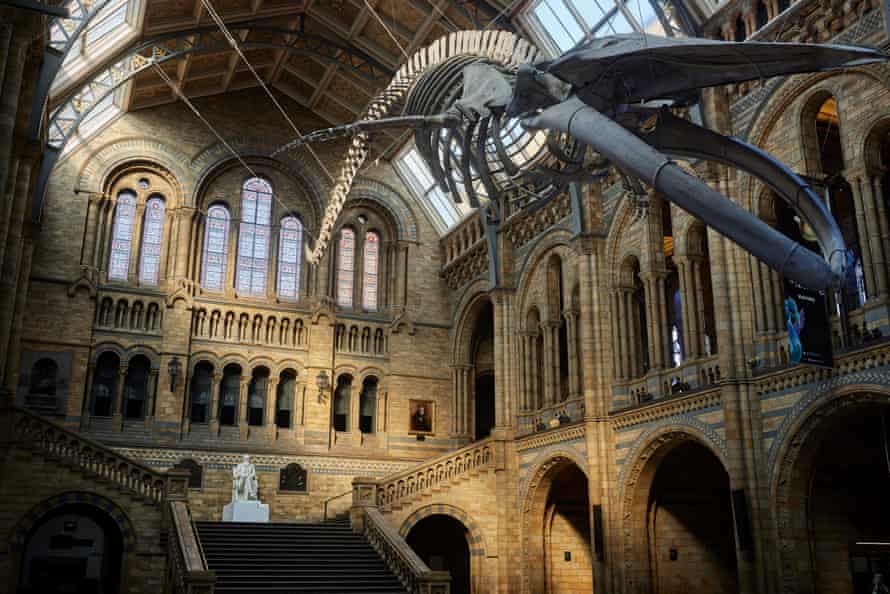
T he main exhibition room at the Natural History Museum in London is cathedral-like, with Hope the blue whale suspended mid-air like a demigod. Filled with specimens collected past explorers, this remarkable identify teaches us about the evolution of life on our planet.
At that place is a "great unlocking" happening in this building, home to i of the earth's largest natural history collections. Insects on pins and old minerals that have been sitting in mahogany brandish cases for hundreds of years are being re-examined, digitised and brought into the 21st century.
In the bowels of the museum – empty due to Covid-19 – scientists are working to protect the planet for the future, too as preserving its past.
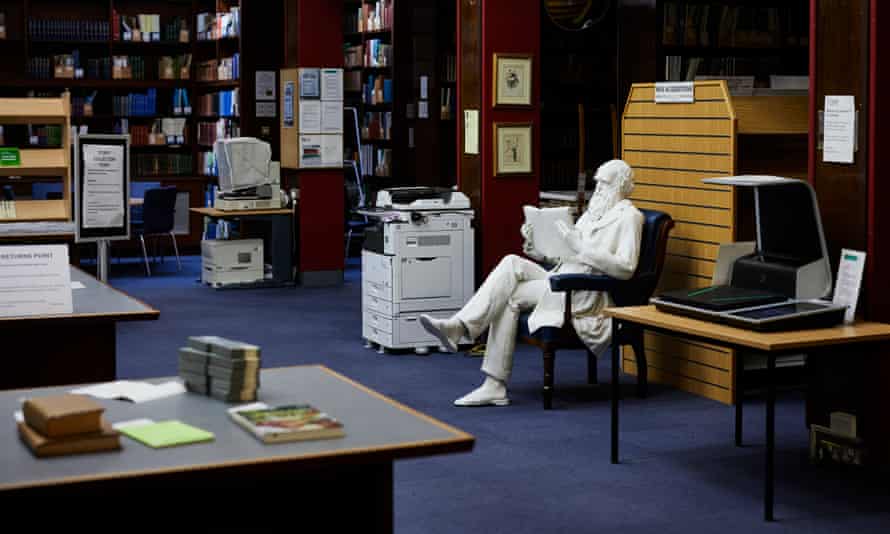
Recording all species
-
'Darwin' catches up on some reading in the offices of the Natural History Museum
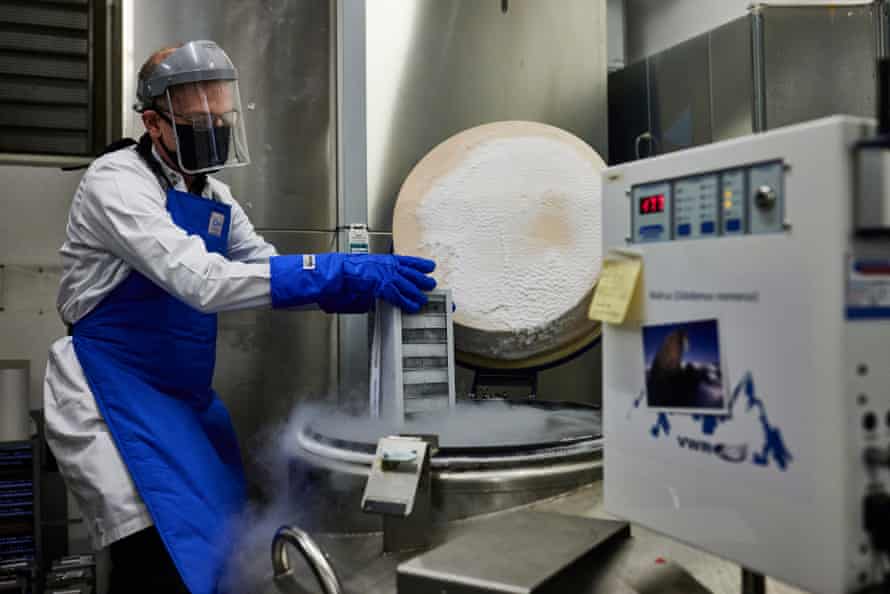
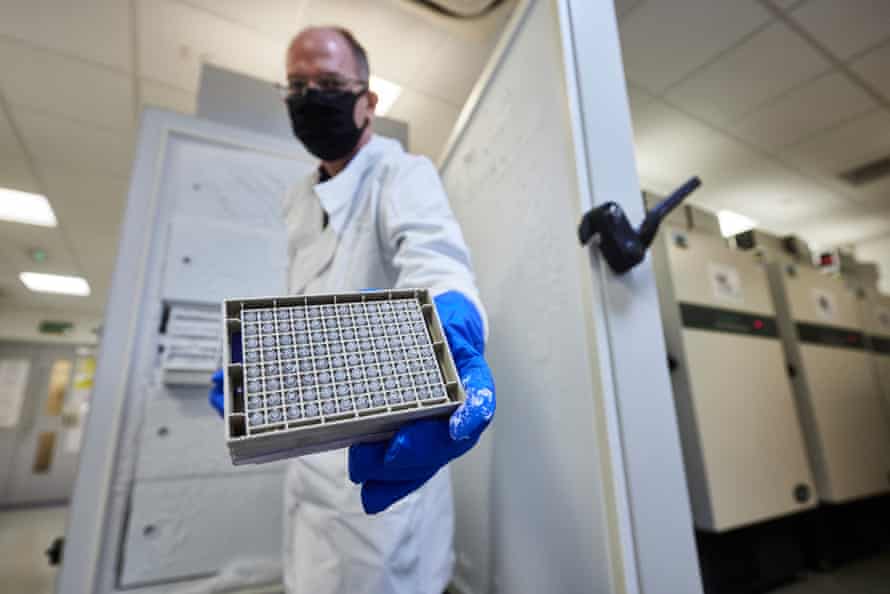
The two white cryogenic tanks in the museum'due south basement can shop genetic data from all 70,000 known species of animal, establish, fungi and protozoa found in the United kingdom. If the Darwin Tree of Life project is a success, Great britain will exist the first land to record the genome of every one of its species.
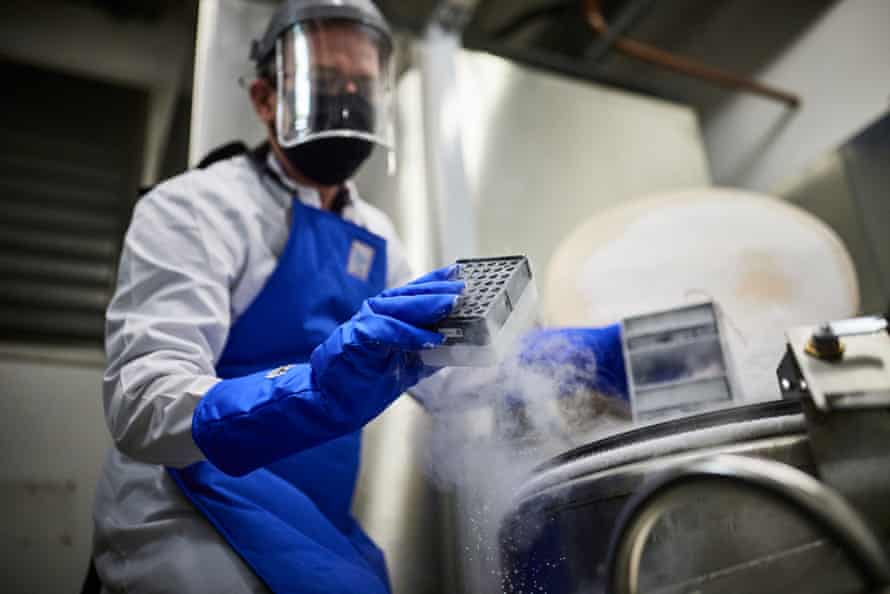
Badgers, bats and beetles are non being stuffed into the tubs of -196C liquid nitrogen, simply lentil-sized samples of their tissues are. This is all scientists need to extract DNA and sequence an entire genome. For some insects this does mean the whole organism; for larger animals information technology could be a drib of blood.
Each sample is put in a little plastic tube inside a drawer. They rotate inside similar a spice rack and, in theory, the DNA should exist protected for always in those conditions. "The amount of information you lot can go from one tiny insect now is incredible," says Dr Gavin Broad, principal curator in charge of insects at the museum.
-
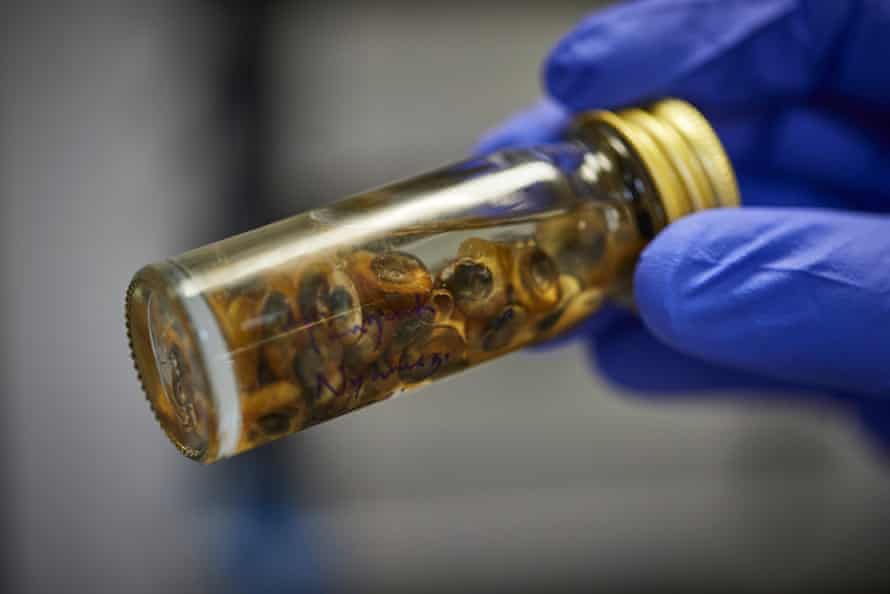
Acme left, Dr Aidan Emery looks at Tanzanian snails which are having their DNA sequenced every bit part of a project researching snail fever, known as schistosomiasis. Other images show samples having their Dna extracted and sequenced for the museum's Darwin Tree of Life project. They are stored at -196C inside liquid nitrogen tanks, where the Dna should be protected for ever
Victorian collectors exploring far-flung lands have been replaced past amateurs recording wild animals closer to home. The project relies on British wildlife enthusiasts contributing specimens by catching them in nets, wading through rivers, or using light traps. A few thousand species (mainly insects and spiders) have already been collected and scientists aim to take them all in the adjacent ten to 12 years.
"Nosotros've got this astonishing network of amateur entomologists out there, then we're getting people sending us specimens in the mail service. The post room must be filled with packages saying 'live insects'," says Broad.
-
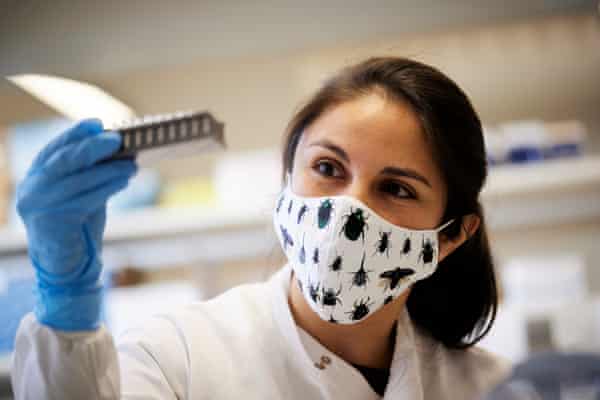
Researcher Maria Belen Arias studies mollusc samples from Republic of chile every bit part of the digitisation process
The museum already has a comprehensive checklist of species to find. Specimens are sent to the museum for barcoding, and to the Wellcome Sanger Institute near Cambridge for full genomic sequencing. It follows on from the Human Genome Projection, widely considered one of the greatest feats of scientific discipline, described every bit biology'due south answer to the Apollo space plan.
"Who knows what sort of advances volition come out of this," says Wide, who describes it every bit a "big infrastructure project". The DNA will show how organisms have adapted to their environment and how they are responding to modify. The projection will open up the residual of the 80 million specimens in the museum to Dna sequencing. "When you've got a fresh genome yous tin can get back to the one-time specimens … You tin can get those tiny fragments of Deoxyribonucleic acid out of hundred-year-onetime specimens and match them to your genome scaffold," says Broad.
The results will be fabricated publicly available online and will class part of the Earth BioGenome Project, which aims to sequence all life on the planet.
Digitising tiny wasps and bugs
-
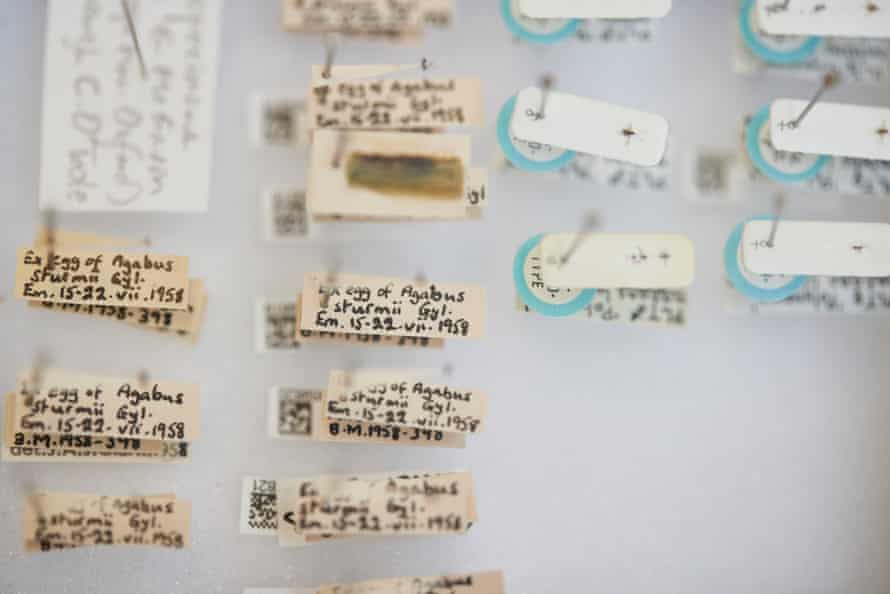
Tiny samples ready to be digitised
Upstairs, Helen Hardy, digital collections programme manager, is getting to grips with some of the older specimens – the museum's chalcid wasps, which are simply a few millimetres long. They look similar bits of dirt to the naked middle and some accept been sitting in an old-fashioned display example for more 100 years. It is hard to go excited most them until you see them magnified, revealing their bright colours and strange-looking wings.
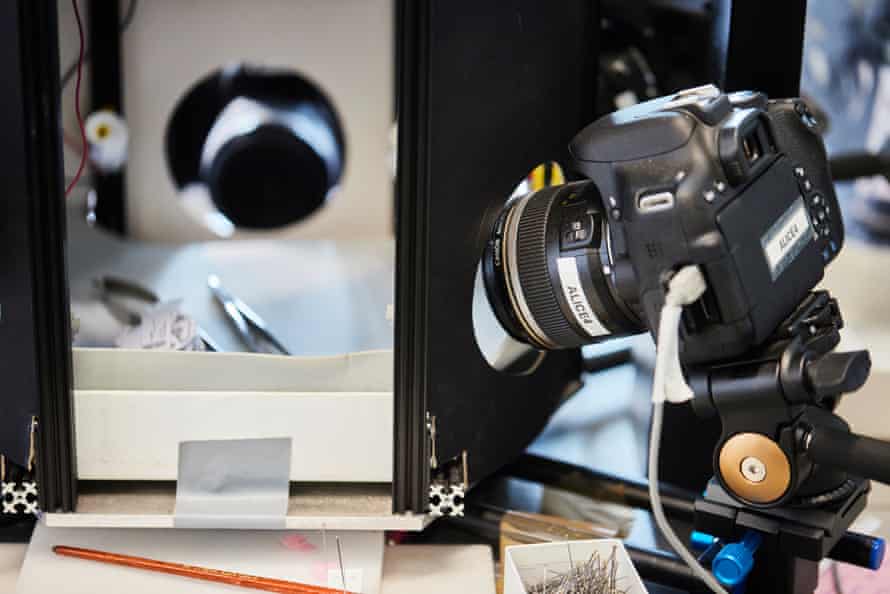
Digitising involves taking high-definition images of the species and then information almost where it was found, when, and by whom. A barcode identifies each one and the process should take less than a minute – provided the label is clear. "The Victorians had actually nice handwriting – people either side non and then much," says Hardy, who has go experienced at deciphering illegible scrawl and has "tricky transcriptions" meetings on Fridays.
In that location are 7,000 species of wasp in the Britain and information on these pocket-size, seemingly unremarkable organisms is proving vital to protecting biodiversity. "Things we overlook are really of import to our food supply – it'southward a bit like called-for a library without checking what books are in it first," says Hardy. Less than 6% of the museum'due south collection is online. Restricted move due to Covid-19 has highlighted the importance of digital surrogates of collected objects, she says.
-
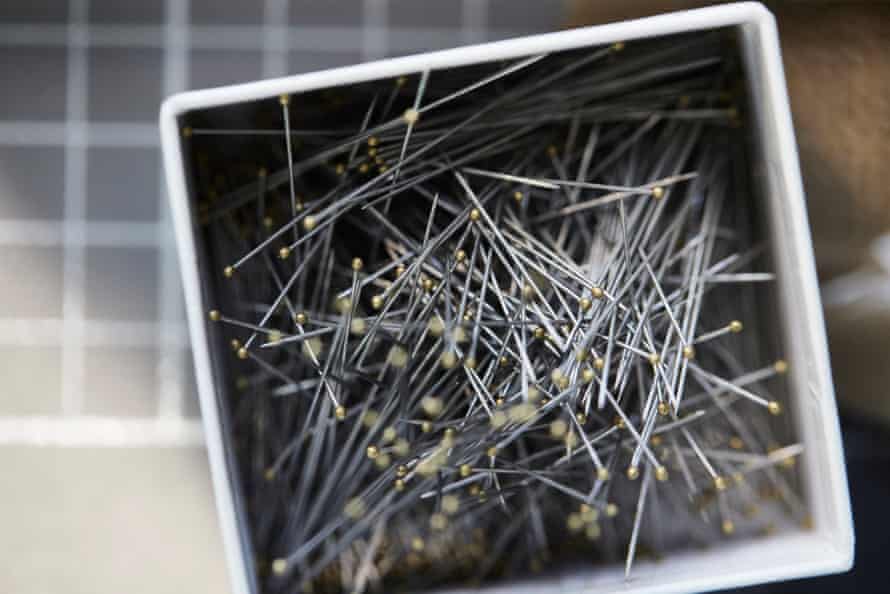
A box of pins still has its place alongside the how-do-you-do-tech equipment, including powerful cameras
The data Hardy and her team are releasing feeds into aggregates, such as the Global Biodiversity Information Facility. There were 25bn records downloaded between February 2015 and February 2021, and none before that. Since 2016, 850 papers accept relied on at least one of those digital specimens, including the UK State of Nature study and Intergovernmental Science-Policy Platform on Biodiversity and Ecosystem Services.
"With things similar Cop26 this year, there are loads of decisions being fabricated about investment and important policy on the environment and conservation," says Hardy. "If they're not using collections information then they're based on, at all-time, a few decades of information. If you actually want to know the state of things before humans started changing state use and making things different, collections are really the only baseline for that."
The museum is part of the Europe-broad DiSSCo project (Distributed Arrangement of Scientific Collections), which involves 115 museums digitising their collections so they are bachelor online for researchers across the world.
Searching for lithium
-
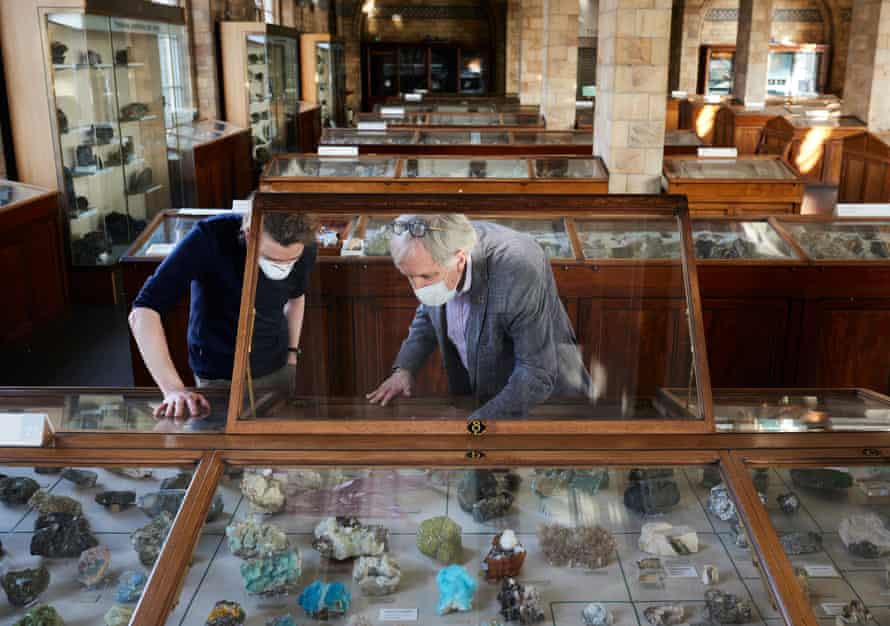
Researchers take discovered new minerals in Victorian displays
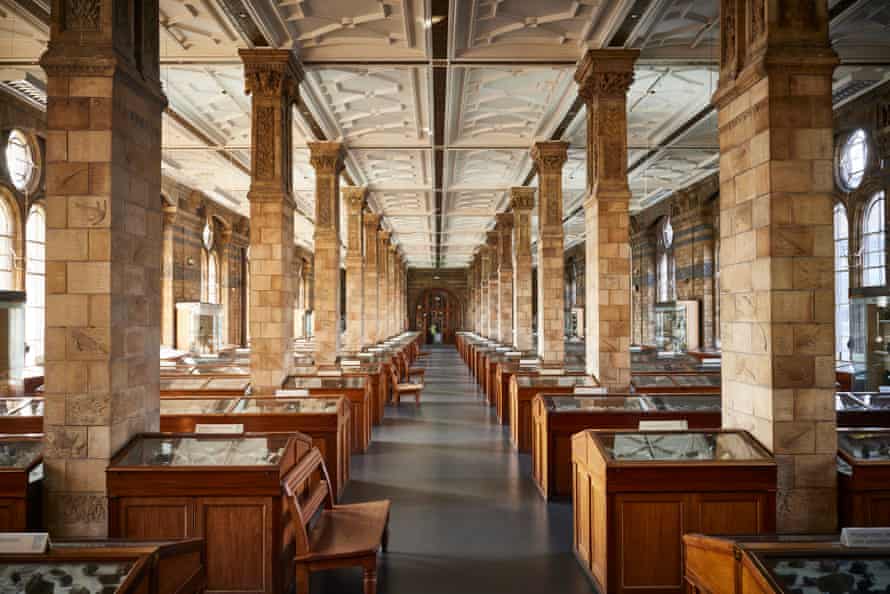
Back in the principal exhibition room, the mineral collection is gear up out as it was in Victorian times, with ornately busy stone pillars, church-like windows and wooden display cases built into the cloth of the building. Less than v% of the 180,000 species of minerals in the collection are on display.
"Finding new things in the collection is definitely my area," says Mike Rumsey, chief curator of minerals at the museum. "I really beloved to expect at the old materials and run across what people have missed in the past because technologies are and so much better. The reason there'southward work for me is considering when loads of things came in, in 1880, they hadn't been analysed to the same level that we tin now," he says.
Last year, Rumsey helped find a new mineral that had been sitting in the drove for 220 years after beingness excavated from a Cornish mine.
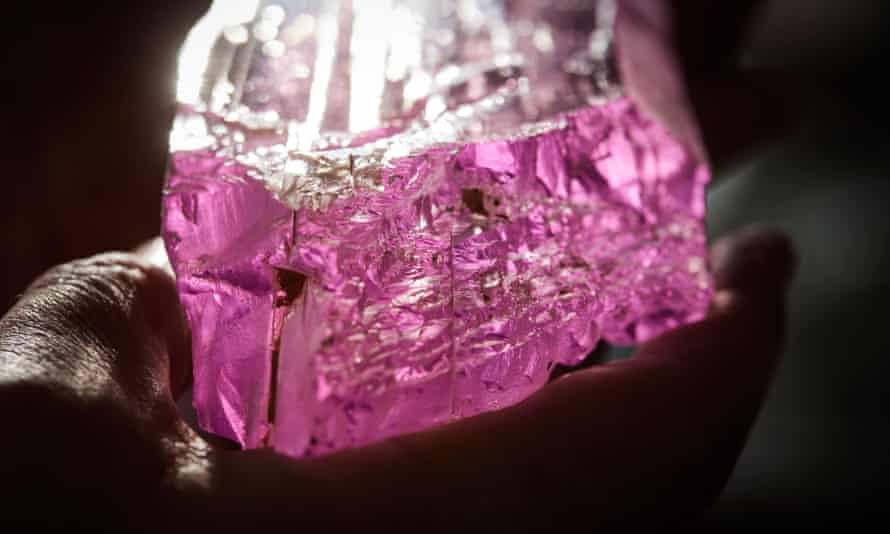
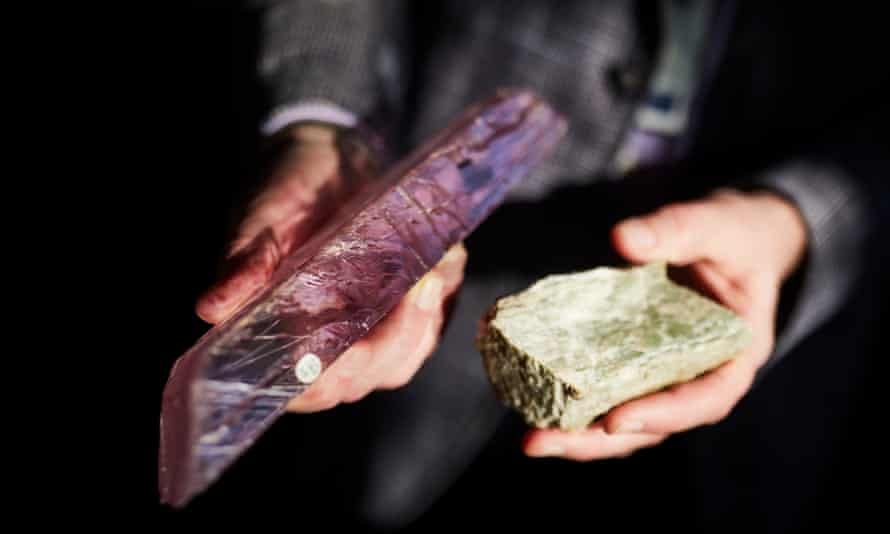
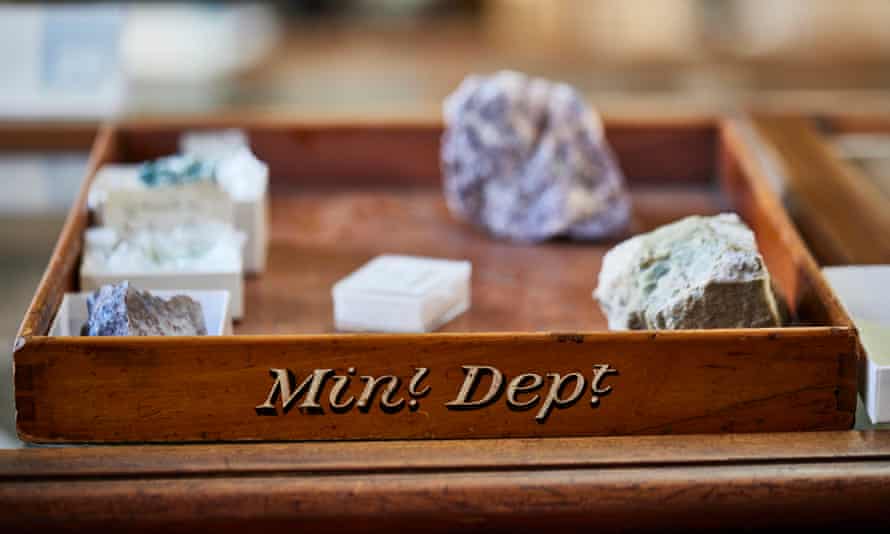
A display case contains a family unit of minerals called spodumene in various shades of pinkish, green and grey. They have one affair in common – they all contain lithium, a metal that will be central to the transition to net zero past 2050. An electric car, for example, requires on average 10 to 15kg of lithium to make information technology, extracted from about 60 tonnes of rock.
-
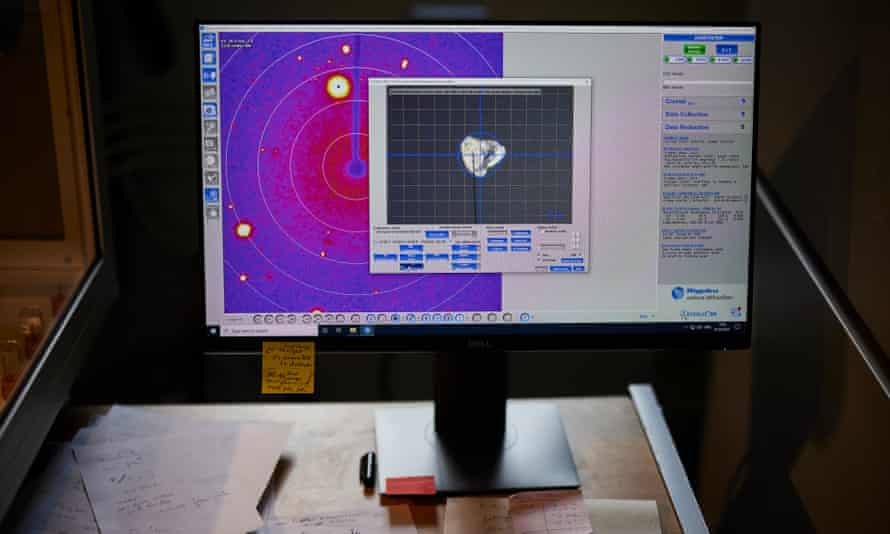
Specimens of a mineral called spodumene, which comes in various shades of pink, dark-green and grey; an X-ray goniometer (lesser-correct) is used to examine them
New lithium-bearing minerals can be identified by their chemical properties and crystal structure, which means how the atoms are bundled three-dimensionally. There are 6,000 known species of minerals globally, with about 100 new species discovered each twelvemonth.
Most of the earth'southward lithium comes from South America or Australia, and there is no commercial production in Europe. It was appear that large quantities of lithium had been discovered nigh the village of Gwennap in Cornwall terminal September. The company that establish it, Cornish Lithium, claimed information technology could be plenty to meet all the Britain'due south demands.
"Nosotros practise know information technology's technically feasible to recover lithium from rocks in United kingdom, says Prof Richard Herrington, caput of the earth sciences section. "Then that's pretty interesting because, if you're looking at having a secure supply concatenation and something that y'all can source locally, mining things closer to home might exist a adept affair."
The museum is working with Cornish Lithium equally office of its Li4UK project, which hopes to find supplies of lithium-bearing minerals in Great britain rocks and geothermal waters. Unlocking mineral data from the drove will provide information for researchers near where they should look for metals critical to the transition to the green economy. In that location might be lithium-bearing minerals still to be discovered in the collection.
'A great unlocking'
-
Covid-xix has highlighted the importance of researchers all over the world having online access to collections
The museum'due south drove is outgrowing the confines of its Victorian structure. Laboratories doing cutting-edge research accept wrapped themselves around the sometime Victorian building like parasites, feeding off its vast resource.
But this is about to change. Over the side by side 5 years, the regime has pledged £180m to the museum to create a new enquiry centre in Harwell, south of Oxford, which will house 40% of the museum's collections, as well equally laboratories and facilities for digitisation.
Although Covid-19 has stopped a lot of piece of work, it has highlighted the importance of researchers all over the world having online access to collections.
"It'due south all part of this great unlocking, and the timing is perfect in a mode because while we're locked downwardly nosotros're doing all the planning for this Harwell move," says Herrington. "It will exist a physical move in the adjacent five years, and nosotros would hopefully escalate the digitisation procedure to increment the collection of new and useful data about individual specimens."
The Natural History Museum will re open up to visitors from Mon, 17 May
Discover more than historic period of extinction coverage here, and follow biodiversity reporters Phoebe Weston and Patrick Greenfield on Twitter for all the latest news and features
Source: https://www.theguardian.com/environment/2021/may/13/no-visitors-but-teeming-with-life-behind-the-scenes-at-the-natural-history-museum-aoe
Posted by: mercerexes1958.blogspot.com
0 Response to "What Is One Animal Inside The Natural History Museum"
Post a Comment